
Two Weeks as President-designate
In the days after Al Gore’s assassination, Joe Lieberman was tasked with assembling an administration of his own.
Who would be in his cabinet?
By the time Gore was assassinated, he had yet to formally announce any of his cabinet picks, though many were chosen and some publicly confirmed in the press. Lieberman saw no reason to make changes to those already known to the public. That meant he would submit the names of those who had been with him when Secret Service agents whisked him to safety after Gore was shot. Richard Holbrooke at State. Robert Hunter at the Pentagon.
Gore had not decided on a Treasury Secretary, but he was leaning towards Erskine Bowles, the former White House Chief of Staff. Lieberman had no interest in having Bowles in his administration. During the Lewinsky scandal, it had been Bowles who called Lieberman to try and talk him out of opposing Clinton. He was a Clinton man. Lieberman didn’t need him.
Larry Summers, the incumbent who indicated he would be happy to stay on under Lieberman “for the sake of the economy,” suffered a similar fate for a similar reason: He was a Clinton man. Lieberman wanted his own team. He nominated James A. Johnson, a former Mondale aide who led Fannie Mae until 1998 and then joined the board of Goldman Sachs.
When it came to Attorney General, Lieberman decided to meddle in home state politics. While Gore had privately settled on Eric Holder for Attorney General, Lieberman decided to name Richard Blumenthal as the next U.S. Attorney General. It steered Blumenthal away from seeking Lieberman’s open Senate seat and cleared the way for another ambitious politician – Mayor Dan Malloy from Lieberman’s hometown – to seek the Democratic nomination. There was likely to be a primary with Congressman John Larson, but that was a fight for a different day.
Lieberman and his chief of staff worked through the rest of the list, keeping a number of Gore’s intended choices for the more minor roles, feeling he had sufficiently asserted his dominance with the picks for Treasury and Justice.
Who would be his vice president?
This was the most important question Lieberman faced, at least as he saw it. He was also constrained by a difficult political reality. The Senate was 50/50, but his vacancy in Connecticut meant that Republican John Rowland would get to make an appointment to fill his seat, which would ultimately be subject to a special election. Democrats warned Lieberman against choosing an incumbent Senator for fear that it would further complicate their monthslong path back to the majority.
Lieberman considered a list of former colleagues: Bob Kerrey of Nebraska, George Mitchell of Maine, and Sam Nunn of Georgia. None of them enthused the president-in-waiting, though he took meetings with each.
He had little interest in tapping House Minority Leader Dick Gephardt, who some had suggested, because Gephardt was so nakedly ambitious Lieberman feared how he would conduct himself as second fiddle.
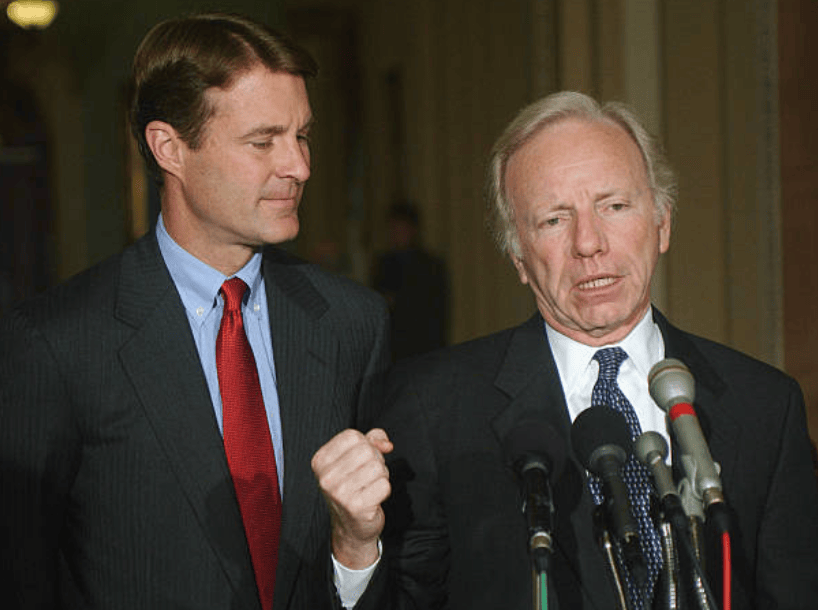
Lieberman then decided to choose someone who reminded him a bit of the running mate he had just lost. Evan Bayh, the young recently-elected Senator from Indiana was a former governor, too, who shared Lieberman’s ideology and presented a fresh face to the American people. The Governor of Indiana was a Democrat, who would appoint someone who could stand in 2002 in a special election. Lieberman thought that would assuage the concerns of the nervous Democrats who feared defending another off-season special election.
Some still complained, citing the fact that 2002 was unlikely to be a good year for the Democrats (Midterms never were) and that they would have an easier time getting Bayh reelected in 2004. Lieberman couldn’t worry about that. He had a job to do, and he needed an able partner. So on January 18, 2001, two days before becoming president, Lieberman addressed reporters and announced he would be submitting Bayh’s name to the House and Senate for confirmation to be the next vice president.
What would he say to the nation?
Lieberman had thought much about the tone he should strike in the wake of January 5th. He and his aides had written and rewritten the speech many times. He wanted to be optimistic without ignoring the very unhealthy election that had just transpired and the circumstances by which he’d assumed the office.
And so, after Lieberman took the oath, George W. Bush, who would not normally have attended the ceremony but was invited by Lieberman as an important display of national unity, looked on as the man not elected gave the speech he had hoped to give.
****************************************
Lieberman’s Inaugural address on January 20, 2001, called for a new era. He thanked President Clinton for his service and even embraced a mantra of Clinton’s – that those in Washington could be “repairers of the breach” – without using those words. Instead, he talked about a new era of American politics: Country First.
“I am confident that we as a nation have what it takes to meet our challenges and renew the American Dream,” Lieberman told the crowd. “We can make it as real for our children as it was for me and my generation. But that will only happen if our leaders are ready to lead, willing to fight for what’s right for the American people, and able to rise above partisan politics to put our country first.” [1]
He had no way of knowing how trying his time as president would be…
>>>>>>>>>>>>>>>>>>>>>>>
[1] This quotation is a modified version of what Lieberman said when announcing his campaign for president in 2003.


Leave a Reply