
January 20, 1977. It’s a frigid January day in Washington as a crowded rostrum of senators, congressmen, and others look on at the 38th president assuming the presidency. The man he is succeeding as president, Richard Nixon, looks on, satisfied that he did all he could over the last eight years to be a good president. The worst of his actions would go unknown for decades…
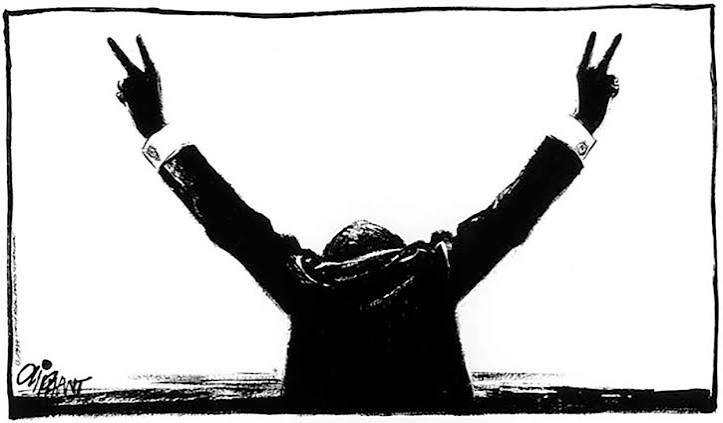
At 12 o’clock noon on August 9, 1974 – 52 years ago this past Sunday – Richard M. Nixon walked to Marine One on the South Lawn, infamously turned to the cameras with his double peace sign salute, and said goodbye to life at the White House. Though he would become a private confidant for later presidents, his time in public life was effectively over. He left office disgraced.
The origin of his downfall was, of course, the Watergate scandal. That “third-rate burglary” that brought down an administration, further eroded America’s confidence in government, and hardened a cadre of rightwing politicos to never again concede defeat in the face of scandal.
But what if America never learned of the Watergate scandal? What if things had transpired differently, and that burglary went off without a hitch? What if Nixon had served his two terms in office? How different might our history have been?
The years of 1973-1977 provide a canvas for a rich reimagining of American history. It was a fraught time. The country’s wounds from Vietnam were not yet over. Its economy was on anything but sure footing. The conservative movement was ascendant as the left receded from its cultural height of the Sixties. Now imagine if Richard Nixon had been in the Oval Office for all of it…
Point of Divergence
When tackling a counterfactual this broad – What if the Watergate scandal hadn’t brought down the Nixon presidency? – we have to first consider the exact point of divergence. Take for example several more specific ways of asking about the world we are trying to imagine:
- What if the Nixon campaign decides not to proceed with any of its ratfucking operations?
- What if the plan for the Watergate burglary was never approved and therefore never even attempted?
- What if the Watergate burglars were never caught?
- What if John Dean never flipped on Nixon?
- What if Nixon refused to resign from office?
For the purpose of this thought experiment, we are going to take the third question. The burglary is pulled off as planned – no one is caught. But one can see how the wording of our What-if might impact the final outcome. If the first question is asked, you have an earlier point of divergence, and without the “Canuck letter,” we are likely to see Ed Muskie win the ‘72 Democratic nomination. If the final question is asked, and much of the Watergate scandal has unfolded per our timeline, then you are likely to see the president impeached and convicted in the Senate – setting-up an unprecedented Constitutional crisis.
But I am most interested in a world where Nixon pulls off the burglary without getting caught. One could naturally argue that achieving this would only embolden the Nixon campaign to do even dirtier tricks down the line, but the historical record confirms that John Mitchell was skeptical of other planned operations, so let’s further assume that while the Nixon campaign engages in its typical amount of ratfucking, it is nothing that rises to such brazen criminality as the burglary.
How does this happen?
In our timeline, the officer who was supposed to respond to the Watergate call was getting drunk at a bar, according to Garrett Graff’s new history, Watergate. The officer who responded in his place was plain-clothed and arrived in an unmarked vehicle, allowing him to slip by Alfred Baldwin, who was on lookout across the street for the burglars.
But what if a misdemeanor earlier in the night prevents the uniformed officer from getting to the bar before he gets the Watergate call. He arrives in his marked police car, which Baldwin spots. Baldwin radioes the burglars to get the hell out – and they do, just in time. The officer inspects the building with Frank Wills, finds no one suspicious, and he assumes that Wills has merely misremembered removing the tape on the door… The burglars are never found out.
Nixon learns of the close call the next day, Liddy is reprimanded for using people so closely connected to CRP and the White House in the burglary, and it isn’t until the mid-2000s when a seemingly obscure White House tape is released and there’s a vague mention of something at the Watergate the night before that historians realize there really may have been some kind of a break-in and that CRP may have been involved.
Nixon’s second term
Nixon – as he did in our timeline – goes on to a 49-state sweep, but that’s about where the convergence with our timeline stops as so much of Nixon’s second term fell under the shadow of this scandal. Without Watergate looming over him, the rest of Nixon’s presidency looks different.
That is not to say it is without controversy, however. The Watergate scandal had essentially no bearing on the tax scandal that consumed Vice President Spiro Agnew and forced him from office. While it is generally argued that House Democratic leadership pressured Nixon to appoint Ford in Agnew’s place because of the scandal and the sense that the next vice president may well ascend to the presidency, there is a compelling case to be made that Ford would have been the preferred choice of Congress anyway. He was one of them, respected by his peers, and not seen as particularly ambitious.
This latter point is important. Nixon’s preferred choice John Connally was essentially dead on arrival because of his past affiliation as a Democrat, and George Bush was seen as a viable presidential contender and one who would be hard to beat in November of ‘76. Democrats did not want to elevate the status of someone who could threaten their chances at the White House. In fact, when Ford nominated Bush as CIA director in OTL, he was forced to sign a pledge that he would not make him his running mate. This has sometimes been framed as an effort to depoliticize the CIA in the wake of the Nixon-era scandals, but I also think this has to do with Bush’s image as a rising star. In this alternative timeline, where Agnew has resigned and Nixon – without the shadow of Watergate looming – must appoint a vice president, I still think Bush is seen as too politically ambitious to sit comfortably with Congressional Democrats. (It’s also worth noting their relationship was not particularly warm in OTL; Nixon may not have even seriously considered Bush…)
To summarize: Agnew still resigns. Nixon is likely boxed into picking Ford, even in this timeline.
Instead, the bigger scandal rests not with the Office of the Vice President but with the Central Intelligence Agency. During the Seventies, the Church Committee unearthed a slew of improper actions undertaken by the CIA throughout the agency’s history. Among the revelations: assassination plots against foreign leaders, particularly Fidel Castro; illegal wiretapping, including of civil rights leader Martin Luther King, Jr; and the famed “heart attack gun,” which prompted one of the hearings most memorable moments.
Even if these scandals are not solely attributable to Nixon – and we can expect that he will go to great pains to emphasize the ones in which the Kennedy brothers were involved – he will still be the one in office as the public learns of these scandals. The Committee’s findings will become the centerpiece of the argument about government transparency. It is a fundamentally different scandal than Watergate, but it will still shock the national conscience – as it did in our timeline.
In our timeline, Congress moved quickly to pass new measures, including the Foreign Intelligence Surveillance Act (FISA), which has become a source of controversy in the post-War on Terror age. But given that Nixon was not exactly fond of government transparency, it’s an open question as to whether or not he supports or opposes these efforts. To some extent they will be an idea whose time has come, but Nixon will be far less willing to sign away essential powers of the imperial presidency than Ford had been.
What state is the economy in? I hardly feel qualified to game this out because the stagflation of this time period was so unique and my own understanding of economics can be wanting at times, but given Nixon’s predisposition to leaning on the Federal Reserve to act according to his wishes, it’s conceivable that inflation remains high throughout this time, keeping employment high enough. Rick Perlstein, at the end of Reaganland, argues that high inflation was tolerable to the American people so long as there was not high unemployment. His thinking is – essentially – people care about having a job and don’t necessarily understand how inflation impacts their daily life. The election of 2024 would seem to disprove Perlstein’s point entirely.
Then there’s the issue of the social safety net. In his first term, Nixon pushed for a gargantuan reform of the healthcare system, introducing a negative income tax, and pushing for the Family Assistance Plan (FAP). It proved too little for the left and too much for the right. When the plan ultimately failed, Nixon spent his time on the campaign trail falling back on standard talking points about how the Democrats were too prone to handouts and welfare expansion. One can assume that in a second term, Nixon might again take up the mantle, but if his campaign rhetoric is any indication of his thinking, it seems that Nixon would move away from FAP toward a more conservative welfare reform proposal. Such a plan might have an easier time in the Senate, but a harder time in the House.
One potential area for narrative intrigue: The Supreme Court. In 1974, Justice William O. Douglas – a hero of the left – suffered a severe stroke that left him incapacitated. He refused to retire because he wanted his seat filled by a Democrat. However, the justices on the bench decided that they would postpone decisions on cases where Douglas’ vote was decisive, which only further exacerbated a feeling Douglas had that he was out of step with the rest of the Court. With Ford in office, Douglas was willing to retire. With Nixon in office, he may have felt compelled to stay. The finish line (the end of Nixon’s term) was well within sight, but knowing what we know about the Nixon organization and their willingness to get into the mud, we could see an especially ugly public fight to get Douglas off the court.
Nixon was not one to appease the masses when it came to his Supreme Court appointments – at least not at first. I think if the opportunity presents itself we can reasonably expect Solicitor General Robert Bork to find himself with the nomination.
Like most second term presidents, one can expect that Nixon would have spent a great deal of time on foreign policy matters. Not only would it save him from having to deal with an increasingly oppositional Congress, but it was also where his great passion was – especially later in his career.
The Nixon years represented a high water mark for relations between the United States and Iran. Nixon and Kissinger backed the shah’s cover operations to boost the Kurds at the expense of the Iraqi government. As Scott Anderson writes in his book King of Kings about the relationship between Nixon and the shah post-1972, “No longer was it anyone’s job to question what the shah wanted or why, but rather how best to facilitate his wishes and further consolidate the bonds between their two nations.”
Earlier in his book, however, Anderson details a particularly striking scene from 1972 in which Nixon, Kissinger, Alexander Haig, and the shah met in the shah’s office. It was then that Nixon told the shah he would be lifting the prohibitions on Iran that had prevented them from buying American weapons – regardless of their human rights record. At the end of the meeting, Nixon turned to the shah and said, “Protect me” (Anderson 71). While we do not know exactly what Nixon meant or even how the shah responded, it underscores the strength of these two leaders’ bond.
Under Ford, relations with Iran were cooler (although not as frosty as they were with Carter), and Ford rejected a plan to send American nuclear exports – negotiations begun under Nixon – because he was not willing to allow Iran to be able to “reprocess spent nuclear fuel, a sensitive nuclear technology that would allow Iran to stockpile plutonium for a nuclear weapons program.” (My source is Roham Alvandi’s thesis, “Nixon, Kissinger and the Shah: US-Iran Relations and the Cold War, 1969-1976)
It is fascinating to imagine a world in which Nixon actually agrees to Iran’s terms, thereby providing Iran the tools to begin its own nuclear exploration. Assuming that the Iranian Revolution still happens more or less on schedule (after Nixon’s second term is over), it would raise important questions for Nixon’s successor: Knowing the developments being made in Iran toward nuclear energy (and weapons), should the United States intervene to save the shah or otherwise involve themselves on the ground?
Regardless of how the 38th president answers that question, Nixon’s decision to allow Iran this technology would become a significant blemish on his foreign policy record, which is arguably the only part of his legacy that still receives praise today. His decision would be something akin to the United States’ arming of the mujahideen during the Soviet-Afghan War. Today’s ongoing War in Iran under President Trump underscores the lasting impacts of American and Iranian relations during this time. One can only imagine how that debate would have unfolded if Iran was even further along in their development – and thanks to the United States supplying them the technology.
A further blemish on Nixon’s foreign policy record would come (again) from Vietnam. The 1975 spring offensive resulted in North Vietnam capturing Saigon. The harrowing images of the last helicopter to leave the city were invoked during President Biden’s withdrawal of American forces from Afghanistan.
In this timeline, with Nixon in office, one can imagine that Nixon would have had more of a stomach than Ford for a sustained aerial campaign with the intention of defending the South. It’s hard to say whether or not this would have been enough to prevent – or even delay – the fall of Saigon, but it would absolutely have driven a surge in Nixon’s unpopularity. The timing would have also cast a large shadow over the election to replace Nixon – marking the third election in which Vietnam was a major issue.
One open question hanging over the entirety of Nixon’s second term is whether or not he would survive. It is bleak to speculate about, but Gerald Ford infamously suffered two assassination attempts: one from Manson affiliate Squeaky Fromme and another from Sara Jane Moore, who later claimed that she was motivated because of the government’s handling of Vietnam and her hope that an assassination of the president would spark a political revolution. (Note: One of my first stories on alternatehistory.com had to do with the premise that Fromme was successful. I’ve since re-imagined that story with Moore, and speculated about that world in an “On this day…” post.)
In addition to the two would-be assassins, the Alphabet bomber had planned – and then abandoned – an attempted attack on Gerald Ford just days after Ford ascended to the presidency. Who knows if butterflies might have convinced him to go after Nixon instead…
The 1976 election
The Republican nominee is likely to be Ronald Reagan in this scenario, no matter how the Nixon years unfold.
In all likelihood, Gerald Ford is the incumbent vice president. I would argue he may not even be inclined to run in his own right. He could have made a serious go of it in our timeline in 1980, but he chose not to because the nomination was anything but certain – and that was after he had experienced the trappings and responsibilities of the office. The argument that Ford would run is akin to the Walter Mondale experience. Mondale passed on a ‘76 campaign but later said that having served as vice president, he gained a newfound appreciation for the power of the presidency, and he decided it was an office worth pursuing. It’s reasonable to assume that Ford would feel the same way. He would enter the race without a natural constituency, however.
Reagan would lock up the right. Nelson Rockefeller, who in this timeline is likely the recently-retired Governor of New York, would certainly make a final go for the nomination. It would almost definitely end in defeat. By this point, there was no room for Rockefeller in the Republican primary.
A big question mark is John Connally – who would be Nixon’s preferred successor. Connally’s biggest problem is that in April 1975 he went on trial for bribery. He was acquitted, thanks in no small part to a slew of character witnesses who testified on his behalf. In our timeline, Connally was most at risk of going down for perjury given inconsistencies in his testimony, but those charges were not pursued, and Connally was acquitted. It’s worth considering whether or not the Richard Kleindienst-led Department of Justice allows this case to reach the point of an actual trial, and it’s also worth considering whether or not Nixon intervening on behalf of his preferred successor might actually blow up in Connally’s face and get him sent to prison or provide an opening for a different scandal that embroils the Nixon White House…
In my opinion, it’s well within the realm of possibility that Connally’s case ends up with charges being dropped or a quick acquittal, allowing the cabinet secretary to launch his presidential campaign with the implicit backing of the incumbent. A Connally campaign is perhaps the most compelling reason to assume that Ford does not get into the race himself.
Just as in 1980, Connally would enter the race with some big donors behind him, but Reagan – despite his wavering early performance in our timeline in ‘76 – would still be the candidate to beat. Connally famously waded into a costly debate over Middle East politics that hurt his standing with Jewish voters. While he may not make the same mistake here, it’s worth considering that he was not a candidate inclined to doing whatever his advisers told him to do. It’s a personality trait that would probably cost him the nomination, to say nothing of the lingering doubts about his integrity and the fact that he was – until very recently – a Democrat.
I think we can safely assume it’s a clean Reagan victory.
As for the Democratic nomination, the assumption is always that Jimmy Carter can’t win without Watergate, and while I myself lean on the side of a different Democratic nominee (Frank Church), it’s worth noting that Carter was planning to get into the race regardless. Hamilton Jordan’s memo outlining Carter’s path to the nomination was drafted immediately after the ‘72 election, and the strategy was largely unchanged after Watergate. Even before the Nixon resignation, Jordan identified that ‘76 would be a change election, that voters were inherently distrusting of Washington, and that a candidate with outsider bona fides would be in a position to win.
He was also correct in learning the lessons of McGovern’s ‘72 campaign. Carter needed to campaign hard in early states to establish credibility and win delegates. Jordan understood what some other strategists had not yet caught up to at this point – the overwhelming majority of delegates would be chosen through these nominating contests around the country. Candidates could no longer afford to skip them or compete in a few hand-selected regional contests. To win the Democratic nomination in the post-68 era required a national campaign from the start. Carter was the only one in ‘76 who was running that kind of operation.
Take for example the quasi-campaign of Hubert Humphrey, who again hoped that the backing of labor and the prospects of a divided convention would be enough for him to become the nominee without putting his name forward as a formal candidate in any of the contests. When it finally became clear to the establishment Democrats they needed to unite to stop Carter, it was too late. The Anybody But Carter movement found there were too few delegates available to swing the convention.
This is the strongest argument in favor of a Carter victory, but there were still plenty of contests where Carter could have been stopped earlier, particularly Florida where a George Wallace victory may have kept Carter confined to the peanut farm.
I posit that without Watergate but with that sense of distrust in government still at an all-time high, the most obvious beneficiary is Frank Church, the senator who led the Church Committee hearings into CIA activity. In our timeline, the committee’s timeline kept Church off the trail most of the campaign season, forcing him to enter late. Jerry Brown’s candidacy was especially detrimental to Church, too, because Church’s path to the nomination hinged on winning California. “California was so critical to Church’s strategy that without a shot in the state, Church’s campaign had no shot at all, recalls Mike Wetherell, Church’s closest traveling aide during the campaign.” (The Last Honest Man by James Risen, pp. 370)
It’s possible that the Committee’s work precludes an on-time Church campaign here, too, but it’s also possible that butterflies enable it to happen ahead of schedule. Or perhaps the famously untransparent Nixon White House drags its feet in cooperating with Congress, making the resulting hearings less productive compared to OTL, but raising Church’s profile even higher, painting the White House as a boogeyman, and compelling Democrats to rally around Church even without a candidate actively on the campaign trail. Or one other path: While Church is stuck in Washington taking on a heroic status, a “Draft Church” campaign takes hold, and he’s able to succeed early on through an organic burst of support that he capitalizes on later… 1976 being an era where something like that was still possible.
I have also heard others make the case that Jerry Brown and Fred Harris stand to gain in a No Watergate timeline.
There was another favorite What-if candidate in the race in 1976, Senator Birch Bayh of Indiana. Bayh is popular among alternate historians for a few reasons. First, he is something of a “modern Founding Father” having written more of the Constitution than anyone not alive at the time of the founding. He is also the father of Indiana governor-turned-senator Evan Bayh, who has a slew of What-ifs associated with him, as well as the grandfather of a current politician, Beau Bayh – who is a candidate both for Indiana Secretary of State and dreamiest Democrat on the ballot in 2026. Bayh’s campaign has something of a failure to launch reputation, in the same vein as Scott Walker in 2016 or Ron DeSantis in 2024, but if there is a general feeling of corruption surrounding Nixon, it could provide an advantage for a candidate who has something of a reputation for writing/defending the Constitution and making Washington work for the people.
A Reagan vs. Church general election campaign would have been a legendary ideological battle. Reagan, though a step too far right for the country at the time, should not be underestimated. He offers a clean enough break from the Nixon administration that he might not be totally bogged down by the president’s assumed unpopularity. In the end, however, I believe it would still be too much to overcome. Church, a hero of transparency in government, who also hails from a state west of the Mississippi, would win comfortably (though nothing close to Nixon’s 49-state landslide of four years prior) and usher in a new era for American politics.
As for what a Church presidency might look like… That’s another post.
Supporting characters
I wanted to spend some time discussing a few people who became household names in the course of the Watergate scenario and how their career may have been different in this timeline. First and foremost, we probably never learn the names Bob Woodward or Carl Bernstein. I’ll discuss later how that would probably be a long term net positive for the country…
But one of the most fascinating characters of the whole Watergate scandal is G. Gordon Liddy. He was one of the chief organizers of the Watergate break-in. In the years after his 52-month prison sentence, Liddy wrote an autobiography, became a talk radio host, appeared in several films, and then appeared in a slew of television commercials encouraging people to buy gold. He had, however, been a lawyer and an FBI agent with political aspirations of his own. He ran for District Attorney and for the U.S. House of Representatives. I have to imagine that without Watergate, his career in Republican politics continues. Could he have won elected office? It seems hard to imagine, but stranger things have happened… One thing is for certain: Whatever height you envision Liddy rising to in your no-Watergate timeline, he will – eventually – fall from it.
John Dean was the White House Counsel who famously flipped on Nixon. In a world without Watergate, Dean likely serves out his time in the Nixon administration and could well enter a future Republican White House. Later in our timeline, he became an impassioned critic of George W. Bush and Bush’s handling of the War on Terror. One of my longstanding alternate history ideas is a takedown of the imperial presidency. Dean always plays a role whenever I game that scenario out. What is the modal outcome for Dean? A place in the cabinet list of the next few Republican presidents until it’s time to teach law or sit on a corporate board.
The Watergate scandal also spawned a collection of politicians known as “Watergate babies.” Technically, the term refers to Democrats who won in the ‘74 midterms, beginning their careers in elected office. Chris Dodd, John Glenn, Gary Hart, and Pat Leahy are among them. But there were also politicians who rose to prominence as a result of the hearing. Lowell Weicker, for example, credits his stature in the Senate to his assignment to the Senate Watergate committee. Liz Holtzman, who was something of an AOC before AOC, and Barbara Jordan both saw their stars rise as a result. While many of these politicians would likely have different trajectories without the Watergate scandal, the ‘74 election would probably be too soon to start changing the path for most of them. Even without Watergate, the ‘74 election year would be brutal for Republicans. Leahy, who won by only three-points, may be an exception.
No Woodward, No Bernstein
Some attention has now been paid to how one president in particular – Jimmy Carter – suffered in the immediate post-Watergate world. After Carter’s death, TIME Magazine ran a piece that picked up on a feeling felt by many in the Carter White House at the time and has since been discussed by historians looking at the Carter legacy. They essentially argue that in the wake of Watergate, reporters were thirsty to become stars themselves. They had just seen two of their colleagues portrayed by Robert Redford and Dustin Hoffman on the silver screen. Jason Robards took home an Academy Award for his portrayal of the Post’s managing editor during the scandal, Ben Bradlee.
The Watergate scandal is not the only contributing factor in the changing of journalism, but it was almost undeniably a turning point. Investigative journalism helped turn Woodward and Bernstein into household names. Woodward in particular took on a larger-than-life status as a perennial court reporter, publishing inside accounts of successive presidencies with a regularity that kept him – and booksellers – turning a profit.
It is worth considering how this obsession with scandal has influenced our politics. Again, there are plenty of factors that have contributed to America’s unprecedented dislike and distrust of its government. Certainly, Reagan’s anti-government rhetoric for eight years changed people’s expectations about how the government could deliver for them in their day-to-day lives, but that was also fed by a certain perception of government… And the idea that “they’re all corrupt” must be – at least partly – influenced by the hunger among journalists to publish the next big “scoop” – and usually that means a scandal.
Really, this is a field of research that could consume a lifetime (for some, it has), and I don’t pretend to be an academic expert, but for me it is easy to draw a throughline from Watergate to the sensationalism of our journalistic coverage and then, finally, a distrust in government officials. That is certainly an aim of the Conservative project writ large, and I am not pretending that government corruption should not be reported on… If it was not Watergate, it would have been something else.
But perhaps it was because Watergate came so closely after Vietnam, perhaps it was because it was a story rich with enigmatic characters (Liddy, for example), perhaps it was because Nixon himself was so downright Shakesperian, or maybe it was because it was really the first brazen example of corruption that went all the way to the nation’s highest office in the television era – whatever it was, the Watergate scandal became a cultural phenom as much as a political one. It became the basis for how to cover and discuss other presidential scandals, and the standard upon which others were based.
There is also the commodification of journalism, which Bob Woodward – arguably – began. I am not referring to journalists publishing historical accounts after-the-fact. For example, Jeffrey Toobin’s 2000 book on the Clinton-Lewinsky affair was a collection of the historical record, and while I am sure it carried new revelations, it was not as though Toobin was getting in-the-moment coverage and then waiting to report on it until his book. Woodward’s Peril, which was published after Biden took office and contained previously unknown bits of information about the inner workings of the Trump White House during the COVID-19, and Jake Tapper’s Original Sin, which was published after Trump II began and contained previously unknown information about the state of Joe Biden’s health, are examples of a grayer area. Reporters learn about information but sit on it until it can take the form of a book so that they can maximize their profit. Something about that feels entirely different from other books about current events.
How do we balance appropriately compensating reporters for their journalism in the digital age with the public’s “right to know”? This is not a question inherently related to the Watergate scandal, but it’s one that our country faces in the new media age. I include it here given Woodward’s prominence in elevating this genre of journalism…
Trust in government
The Watergate scandal does not bear sole responsibility for the erosion in trust of the government. The Vietnam War absolutely played a role as did later attempts by the right to capitalize on those feelings for political gain. That said, it would be hard to overstate how badly Watergate damaged the national psyche.
It is the only event that has ever compelled an American president to resign his office. It also produced some enduring myths about political scandals – maxims like “Follow the money” and “The cover-up is worse than the crime.”
It also spawned reforms to our campaign finance system. Many of them were gutted in the Buckley v. Valeo decision shortly thereafter, but the concept of federal matching funds for candidates to reduce their dependence on outside contributions endured until the 2008 presidential election, when Barack Obama and his internet fundraising machine compelled him to eschew the public financing. During Obama’s presidency, the rightwing Supreme Court’s Citizens United decision opened the floodgates for Super PACs and untraceable, unlimited spending on elections. The rules were further relaxed earlier this year, when the Supreme Court functionally decided that a dollar to a political party was – for all intents and purposes – equivalent to a dollar to a political candidate, allowing parties and candidates to coordinate their spending, providing donors a vast loophole around the cap on how much they can give an individual candidate.
Today’s campaign finance system is just a small part of the current aura of corruption in government. The brazen corruption of the current administration is nearly impossible to keep up with, and underscores one of the most important lessons learned from the Watergate scandal: Nixon only had to resign because his own Party stood up to him. Such is the reality of governance in a two-party system.
The Vice President of the United States appeared recently at the Nixon Library and remarked that if it happened today, Watergate would just be a “12-hour news story.” It was “crazy,” he said that it had taken down an entire presidency. It is hard to refute the vice president’s conclusion, but I would argue it says more about the derelict state of our Republic than it does about the scandal. The problem is not that Watergate was considered egregious enough to take down a presidency. The problem is that it feels today like nothing is…


Leave a Reply